“Pak Sim Data” Lookup Sites Explained

“Pak Sim Data” Lookup Sites Explained

Own-CNIC checks only · Reviewed 28 August 2026 · This site has no search box

“Pak Sim Data” Lookup Sites Explained: Live Tracker, Minahil, Pak Sim Pro and the Rest

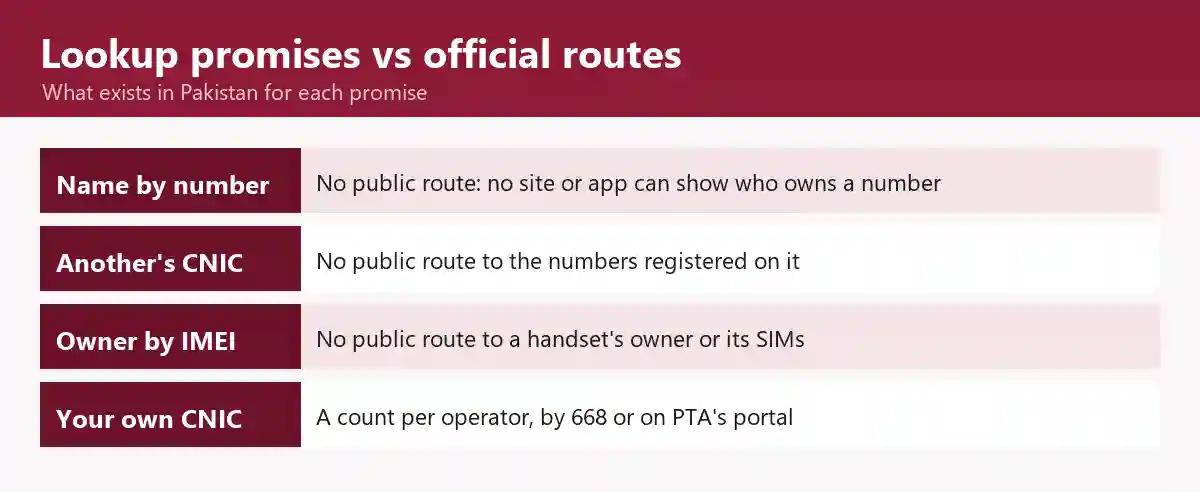
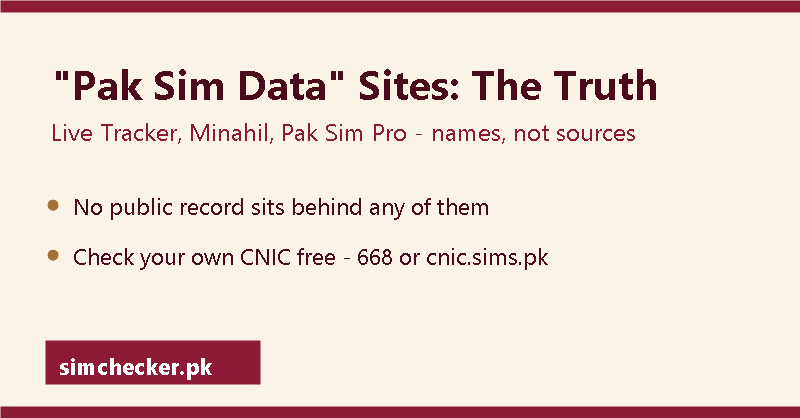
“Pak sim data” and the site names people search alongside it — “live tracker”, “minahil”, “pak sim pro”, “paksim ga”, “sims bio” and the rest — are search strings, not sources. No public record sits behind any of them. The check that works is your own CNIC: free at cnic.sims.pk, or about Rs 2 by SMS to 668.

Contents: Live tracker sim dataMinahil sim dataPak sim proPaksim gaStability noteSites searched by nameSim data update & sims bioTyped site namesAPK risks

“Live Tracker Sim Data”: The Search Term, Examined

“Live tracker sim data” is a search phrase, not a licensed product. The word “live” promises a real-time link to operator records, and no public page has that link. Ahrefs shows this family at 13,000 searches a month, which proves the demand is real even though the service is not.

Breaking the phrase into its three words

Three words, three separate promises, and each one fails on its own. Pulling them apart is the fastest way to see why the whole phrase collapses. Nobody sat down and designed this name. It grew out of what people hoped somebody had built.

“Live” — a claim of a real-time feed

Live means a connection open right now to a system that updates itself. Only the six operators run such systems, and PTA reads them under its own regulatory powers. No operator sells that connection to a website, and no licence to buy one exists.

“Tracker” — a claim of location

Tracker means position. Position data is generated by towers and stays inside the operator’s own network. Police and the NCCIA reach it through a lawful order in a registered case, and that is the only door.

“Sim data” — a claim of name and CNIC

This is the piece people actually want. A stranger’s name and CNIC are identity information, and identity information is protected. The sim owner details of another person are not something any consumer page can lawfully show you.

Why the APK versions are the riskiest part of this family

A large share of these searches end in the letters “apk”. An installable file asks for far more than a web page ever could: your contacts, your messages, your storage, sometimes your screen. You hand all of that over before the app has shown you anything at all.

And it still cannot answer the question. There is no hidden database inside the file, because the data was never available to put there. What you are left with is an unknown app holding permissions over the phone you use for banking. The table sets the common variants against what came back from them.

Variants of the “live tracker sim data” phrase and what each one delivers
Phrase variantWhat it promisesWhat actually happens
“live tracker sim data”A real-time subscriber lookupAn empty panel; no feed exists to read
“live tracker sim data apk”The same thing, offline, in an appPermissions handed over, no answer returned
“live tracker sim owner details”A name behind any numberBlank, or a guess from an old leaked list
“live tracker sim data cnic”Every SIM on somebody’s CNICOnly your own CNIC returns a count, on PTA’s portal

The honest verdict, and the check that does work

The demand is genuine and the product is not. Ahrefs puts this keyword family at 13,000 searches a month in Pakistan. That number measures how many people want an answer, and nothing more. The same pattern runs through every one of the SIM checker, finder and tracker tools people search for.

The check that does work takes about a minute. Open cnic.sims.pk, type your thirteen digits with no dashes, clear the reCAPTCHA, press Submit, and read the count of SIMs on your card. For an unknown number, sending “N 03001234567” to 76367 for Rs. 2 plus tax returns the network it sits on, and nothing about the person holding it.

No consumer app in Pakistan holds a live feed of operator subscriber records.

“Minahil Sim Data” and Similar Named Search Terms

“Minahil sim data” is a spelling family, not a company. People type it as minahil, manahil and minhal, and all three land on the same idea: a list of numbers matched to owners. That list is unlawful to hold under PECA 2016, and the official PTA check remains the only real answer.

The three spellings and why they all exist

The name travels by word of mouth. Somebody hears it in a shop or a WhatsApp group, types what they heard, and Google fills in the rest. Nobody is reading it off a signboard, so the spelling scatters. Treat all of it as a search string and nothing more. The “fresh sim data” and “sky sim data” names travel the same way.

minahil

The most typed version, usually paired with “check” or “by cnic”. It carries the same wish as every other phrase in this family: a stranger’s name from a number on a screen.

manahil

The same name with the vowels swapped, which is how it sounds in ordinary speech. Search engines treat the two as near-twins and often show the same set of pages.

minhal

The short version, typed by people who heard it quickly. It lands in the same place. Nothing about the shorter spelling changes what is or is not available.

Spellings people type in this family and where each one leads
Spelling people typeWhere it leads
“minahil sim data”Pages built on the phrase, holding no subscriber record
“manahil sim data”The same set of pages, same empty ending
“minhal sim owner details”The same again; the short spelling changes nothing
“minahil sim data check by cnic”What the searcher wants is PTA’s own portal, cnic.sims.pk

One answer that covers all of them

No page under any of these spellings holds a feed from Jazz, Zong, Telenor, Ufone, Onic or SCO, because no such public feed exists. The sim owner details of another person are not available through any of them. What is available is the count of SIMs on your own CNIC: free through PTA’s SIM Information System at cnic.sims.pk, or for about Rs 2 by sending your thirteen digits to 668.

The spelling changes, the answer does not: your own record is checkable, someone else’s is not.

“Pak Sim Pro”: What People Are Looking For

“Pak sim pro” is among the highest-demand phrases in this whole category, and paid keyword tools score it at zero volume. Our own Search Console data shows 19,088 impressions on one spelling alone. The searchers want owner details from a number, and that is exactly what no lawful service provides.

The spellings people actually type

Four shapes carry nearly all of this traffic. They are the same three sounds with the spaces moved around, which is what happens to a name that spreads by speech instead of print. The table sets each spelling against what we can actually measure, and the “paksim ga” section below covers the sister name.

Spellings in the “pak sim pro” family and what each one is really asking for
SpellingReal impressionsWhat the searcher wants
“paksimpro”19,088 in our own Search Console dataA name behind an unknown number
“pak sim pro”Zero in paid keyword toolsThe same thing, typed with spaces
“paksim pro apk”Zero in paid keyword toolsAn installable version of the same wish
“pakistan sim pro”Zero in paid keyword toolsThe full country name, same intent
“paksim. pro” or “pak sim.pro”Zero in paid keyword toolsThe address spellings, dot in a different place
“paksimpro.pk” or “pak sim pro.com”Zero in paid keyword toolsA guessed web address for the same wish
“paksim.pro apk” or “pak sim pro free apk”Zero in paid keyword toolsThe installable version, free or paid
“pak simpro login”Zero in paid keyword toolsAn account page that does not exist

paksimpro

One word, no spaces. This is the spelling that carries the measurable demand in our data, and it is usually typed on its own with nothing after it.

pak sim pro

The spaced version, often followed by “cnic check” or the name of an operator. The added words tell you the searcher is thinking about registration, not about the app. The sim owner details they picture do not sit inside any app.

paksim pro

The half-spaced middle ground, and the one most often paired with “apk”. An unknown installable file is the riskiest thing in this whole family. An old file is no safer: “pak sim pro apk old version” and “pak sim pro free apk old version” point to the same unknown installable.

pakistan sim pro

The long form. People who type the full country name are usually new to the search and still expect an official-looking answer at the end of it. Nearby spellings — “pakistan simpro pk”, “pak sim data pro”, plain “sim data pro” — carry the same intent and end the same way.

Why paid tools score this at zero and Search Console does not

Keyword tools estimate. They model volume from clickstream samples, and a phrase that lives mostly on cheap phones and in one country slips through that model. Zero in the tool means no signal, not no people.

Google Search Console counts differently. It reports what Google actually served, from Google’s own logs, for pages that already rank. That is why one spelling shows 19,088 impressions while the paid tool shows nothing at all. When the two disagree, the log wins. The same gap shows up across every name on this page.

What to do with the same intent, lawfully

The intent behind these searches is fair enough. Three official checks answer as much of it as anyone is allowed to answer, and all three keep you inside your own sim owner details rather than somebody else’s.

Check your own CNIC on cnic.sims.pk

Thirteen digits, no dashes, on the page titled SIM Information System. Clear the reCAPTCHA marked “Verify:” and press Submit for a count split by operator.

Send your own CNIC to 668

Same record, no browser needed. The 668 SMS service is sender-bound, reading the digits you type and the SIM you send from, so a stranger’s number in the body does nothing.

Send “N 03xx3456789” to 76367 to learn only the network

Letter N, a space, then the eleven digits, for Rs. 2 plus tax. It returns the network a number sits on today. It returns no name, no CNIC and no address.

High search demand for a phrase is not evidence that the thing it names is real.

“Paksim Ga”: The Most Searched Name in This Category

“Paksim ga” is the single most typed name in this category, at 14,461 impressions on one spelling in our own data. The odd “.ga” ending is a free country domain, which is why the name looks strange. The lawful answer for every one of those searches is the PTA portal.

Where the “.ga” in the name comes from

Those two letters are a country code, not a Pakistani word. They belong to Gabon, and for years that ending was handed out at no cost to anyone who asked. Cheap addresses attract sites that do not plan to stay long, which is how the letters ended up inside a name people now say out loud. Some even search “pak sim ga located”, asking where the site sits — the ending points to Gabon’s registry, not to any office in Pakistan.

It matters because the ending is doing work in people’s heads. A web address looks official. It is not a registration, not an approval and not a sign that anybody checked what sits on the other side. The “pak sim pro” section above covers the sister name.

The four spellings that carry the demand

Four spellings carry nearly all of it, and not one of them ends in a stranger’s sim owner details. The table shows where each version of the name actually sends people.

Spellings in the “paksim ga” family and where the traffic goes
SpellingWhere the traffic goes
“pak sim ga”Pages built on the phrase, holding no operator record
“paksim ga”The same set of pages, same empty ending
“paksimga”Closed-up spelling, identical results
“pak sim ga apk”An installable file, which is the riskiest version of all
“pak sim.ga” or “pak sim .ga”The domain typed as part of the name, same pages
“paksim. ga” or “pksim ga”A stray space or a dropped letter, identical results
“pak sim go”The name misheard as “go”, still the same pages

pak sim ga

Three separate words. This is how most people first say the name to somebody else, and it is often followed by an operator name like Jazz or Zong.

paksim ga

The middle spelling, and the one carrying 14,461 impressions in our own Search Console data. It is usually typed alone, with nothing after it.

paksimga

One closed word, typed by people in a hurry on a small keyboard. The results that come back are the same.

pak sim ga apk

The file version. An unknown app asks for your contacts and your messages before it shows you anything, and it holds no subscriber data to show. An older date changes nothing: “paksim ga 2019 apk” is the same unknown file, only older.

The honest replacement for this search

PTA’s SIM Information System at cnic.sims.pk. Thirteen digits, no dashes, reCAPTCHA, Submit, and your sim owner details come back as a count split by operator. The same record arrives by SMS if you send those digits to 668. Neither route will ever return a stranger’s name, because neither was built to.

A free top-level domain is not a licence, an authority or a source of subscriber data.

“Stability Note”: The Search Term Explained

“Stability note” is a phrase people type when they are looking for SIM data, and it is often typed alongside “pta” and “668”. That pairing tells you what searchers actually want: the official PTA check. The official check is free, and it needs no third-party page at all.

Why this phrase is typed so many different ways

Nobody reads this name off a page. It is heard, half-remembered, and then typed at speed on a phone keyboard. So it arrives as “stability note”, as “stability no.com”, as “stability not dot com”, and as spellings that lose a letter along the way.

The scatter is the useful part. A term that is only ever spoken has no official source behind it, or the spelling would settle down. What holds steady across every version is the intent, and the intent is easy to read once you line the variants up. Every name in this group gets the same treatment across this page.

Typed variants of the “stability note” search and what each searcher meant
Typed variantWhat the searcher meant
“stability note”Somewhere to check SIM registration
“stability no.com”A guessed web address for the same thing
“stability not dot com”The address spoken out loud, then typed
“stability note pta”PTA’s own portal, cnic.sims.pk
“stability note 668”The official SMS check on 668

The “pta” and “668” clue inside the search data

Two of the most common variants carry an official word inside them. Somebody who types “pta” or “668” has already heard that a proper route exists and is trying to find it through a half-remembered name. They are one step away from the real answer.

That answer is short. PTA’s SIM Information System at cnic.sims.pk takes exactly thirteen digits with no dashes, a reCAPTCHA and a Submit. The same record comes back if you SMS those digits to 668. Both are sender-bound to your own CNIC and your own SIM, which is why your sim owner details show up and nobody else’s ever will.

When people add “pta” or “668” to a search, they are already asking for the official route.

Lookup Sites People Search By Name: One Answer for All of Them

Dozens of site names get typed into Google every month for the same request, and one answer covers all of them. None of these search strings leads to a lawful stranger lookup. Your own SIM record is checkable free on PTA’s portal, and that is the whole of what any site can honestly offer.

Why so many different names share one search intent

The names keep changing and the person typing them does not. Someone got a call at two in the morning, or a message asking for a bank code, and they want a name to put on it. So they type whatever a cousin told them to type — “pak data cf”, “pak data ga”, “pak e services sim data online check”. Different words, one wish underneath: sim owner details for a number that is not theirs.

These strings are not separate products. Some are addresses that stopped loading years ago, some are copies of copies, and some were never more than a page with a box on it.

The single answer that fits every one of them

One reply settles the whole list. Your own record is open to you free, a number’s current network costs two rupees by SMS, and another person’s sim owner details are not on sale at any price. No new name added next month changes those three lines.

The table below matches each kind of search string to what the person typing it actually receives.

Search strings people type, and the lawful answer to each
Search string typedWhat the searcher wantsThe lawful answer
“pak data sim”A name behind a numberNot available. Your own SIM count is free on cnic.sims.pk.
“pak e services”A government-looking recordPTA’s portal is the record, and it shows you only your own.
“pak data sim info”Name, CNIC and address togetherNever released publicly. Sharing it is an offence.
“pak database sim”A searchable copy of the operator filesNo such public copy exists to search.
“pak data apk online check”An app that does it fasterNo app holds data the portal lacks.
“pak data.ga” or “pak data ga”The same name typed as an addressNothing loads that any operator feeds.
“pkdata ga” or “pk data cf”Dropped letters, the same requestYour own count is free on cnic.sims.pk.
“pak data.cf” or “pak cf data”The .cf ending, another free domainNo free domain holds subscriber files.
“pakistan database” or “pakistan database agency”An official-sounding national listNo such agency exists; PTA is the regulator.
“alidatabase”A person’s name attached to a listA first name is not a data source.

Your own record: cnic.sims.pk or 668

Thirteen digits, no dashes, on PTA’s SIM Information System or by SMS to 668. Both return the count on your CNIC, split by operator.

A number’s network only: 76367

Send N, a space, then the 11-digit number to 76367 for Rs. 2 + tax. The reply names the network. No name, no CNIC, no address.

Someone else’s identity: no lawful route exists

668 reads the CNIC you type, and 667 answers only for the SIM that sends the message, returning that SIM’s own registered record. A stranger’s number in the body does nothing on either code. The rest of this page walks through these names one by one.

One answer covers every name on this list, because every name is chasing the same impossible promise.

“Sim Data Update”, “Sims Bio” and “Cnic Shop”: Same Question, Same Answer

These three phrases look unrelated and mean the same thing. Each is typed by someone who wants a number turned into a name. The answer is identical for all three: your own SIM record is free to check on PTA’s portal, and no page can lawfully sell you somebody else’s.

Three names, one intent

Read them aloud and they sound like three businesses. They are three ways of asking one question, often by the same person in the same week.

“sim data update”

The word update sounds official, as if a record is being refreshed. Nothing is. Your operator’s file changes only when you stand at a franchise with your thumb on the scanner.

“sims bio”

Bio suggests a profile with a face and a name on it. No public profile exists for any Pakistani number. The word comes from social media, not from telecom. People type it as an address too — “www.sim.bio data” — and the guessed address loads nothing official.

“cnic shop”

This one is honest by accident. It says out loud that identity is being treated as a thing to buy. Buying is an offence for the buyer too.

The one answer for all three

Send your own 13 digits to 668, or type them on cnic.sims.pk, and your count comes back in seconds. That is the full extent of what anyone can lawfully hand you, and a SIM data check in Pakistan is a check on yourself.

Set the three phrases against what each one can actually deliver.

What each phrase promises, against what is actually available
PhraseWhat it seems to promiseWhat is actually available
“sim data update”A refreshed record on any numberYour own SIM count, free, on PTA’s portal
“sims bio”A profile with a name attachedNo public profile exists for any number
“cnic shop”Identity details for saleNothing. Buying identity data is an offence.

The name on the search box changes every few months; the legal position has not changed since 2016.

Site Names People Type Straight Into Google: What You Will Find There

Many people skip the search entirely and type a site name straight into Google. Our data shows dozens of these strings, most of them misspelled. What you find at the end of them is always the same shape of page, and none of them can return a stranger’s identity lawfully.

Why people type a site name instead of a question

A name is easier to remember than a question. Somebody at the shop said a word, you half caught it, and later you type what you heard — “simoner details”, “simownership check online”, “simownerdata”. The spelling wanders because nobody read it, they heard it. The person is not loyal to a brand. They want sim owner details, and a half-remembered word is the only handle they have.

What the pages behind these names have in common

The pages differ in colour and in nothing else. See three of them and you have seen the pattern, which the table below sets out string by string.

What the most-typed strings actually reach
String typedWhat kind of page it reaches
“simownerdetails”A single page built around one input box
“simoner details”A misspelling Google sends to the same kind of page
“simownership details pakistan”The same promise with a country word added
“simownerdata”Often a parked or dead address with nothing behind it

A box that asks for a number

The box is the whole design. It invites the one act the law places out of bounds.

A promise made above the fold

Name, CNIC and address in a single line, before you have scrolled. No source is offered, because none can be.

No named source and no legal note

PTA is never named, no section of the law is quoted, no verification date appears. Compare that with how a real online SIM details check works.

A domain name is not a source, and typing one into Google does not make the promise on it true.

SIM Owner Details APK and “Sim Data” Apps: The Risk You Take

Installing a “sim data” APK is the most dangerous move in this whole category. These files are hosted outside Google Play, ask for permissions no lookup needs, and cannot deliver what they promise anyway. The official checks need no app at all: a browser and your Messages app are enough.

Why these files sit outside Google Play

An app promising another person’s name and CNIC cannot pass a store review, so it gets passed around as a raw file. You are told to allow installs from unknown sources first, and that instruction is the warning. Strings like “pak sim data apk”, “live tracker sim data apk” and “minahil sim data apk” are searched thousands of times a month, and not one of them reaches a lawful source of sim owner details.

The permissions these APKs typically ask for

Look at what the file wants from your phone and the purpose becomes clear. The table sets each request against what a record check would honestly need.

Permissions such files request, against what a lookup would actually need
Permission requestedWhat it can reachWhy a lookup would never need it
ContactsEvery name and number saved on your phoneA record check reads one CNIC, not your address book
SMS read accessBank codes and one-time passwords as they arriveNothing about a SIM record lives in your inbox
Storage and filesPhotos, downloads, scanned CNIC copiesNo official check asks you for a file
Device and call informationYour own numbers, IMEI and call logYour operator already holds this

Contacts

Your whole address book leaves the phone in one tap, and those people never agreed to it.

SMS read access

This is how bank one-time passwords end up with somebody else. The costliest permission on the list.

Storage and files

Most Pakistani phones hold a photo of a CNIC somewhere. Storage access finds it.

Device and call information

Your number, your handset identity and who you call, collected quietly.

What to do instead, with no app installed

Three official routes reach your own sim owner details without a single download. If one of these files is already on your phone, our guide to SIM scams and safety problems covers the cleanup.

Open a browser and go to cnic.sims.pk

Type your 13 digits without dashes, clear the reCAPTCHA, press Submit, read your count.

Open Messages and send your own CNIC to 668

The same 13 digits, sent from your own SIM. The reply breaks the count down by operator.

Dial your operator’s own-number code from the keypad

It reads the SIM already in your phone and shows that SIM’s own number, nothing more. The operator-published codes are Jazz *99#, Zong *8#, Telenor *8888# and Ufone *780*3#, free on all four networks. Onic handles it inside its app, and SCO has no code — its helpline 355 answers instead.

A lookup that only reads a public record has no reason to ask for your contacts or your SMS.

Related guides: why no public SIM database exists · SIM safety, scams and failed checks · what a number can and cannot tell you.

← Back to the main guide