
Own-CNIC checks only · Reviewed 4 September 2026 · This site has no search box
Most people who search for number details are not curious about a number. They are deciding something: whether to call a missed number back, whether a message really came from their bank, whether to send a deposit to a seller, or whether the person who keeps ringing knows where they live. A number itself answers very little of that — its shape, its network and whether it is still active — so this page works the other way round. Start from the situation you are in, see what the number can and cannot settle, and take the step that actually protects you.
No number in Pakistan reveals its owner to the public. Read its shape, confirm its network with 76367, then judge the person by what they ask you for — not by any “details” a website offers to sell.
Contents: Read the shape of the numberSeven situations, one at a timeThe five-question trust testWhat each official check gives backThree beliefs that cost people moneyQuestionsRoman Urdu
Read the shape of the number before you read anything else
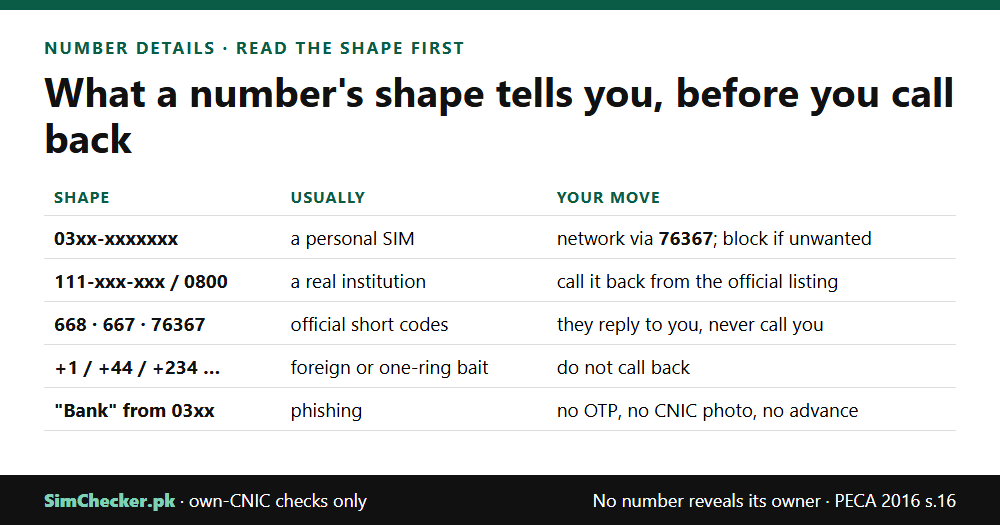
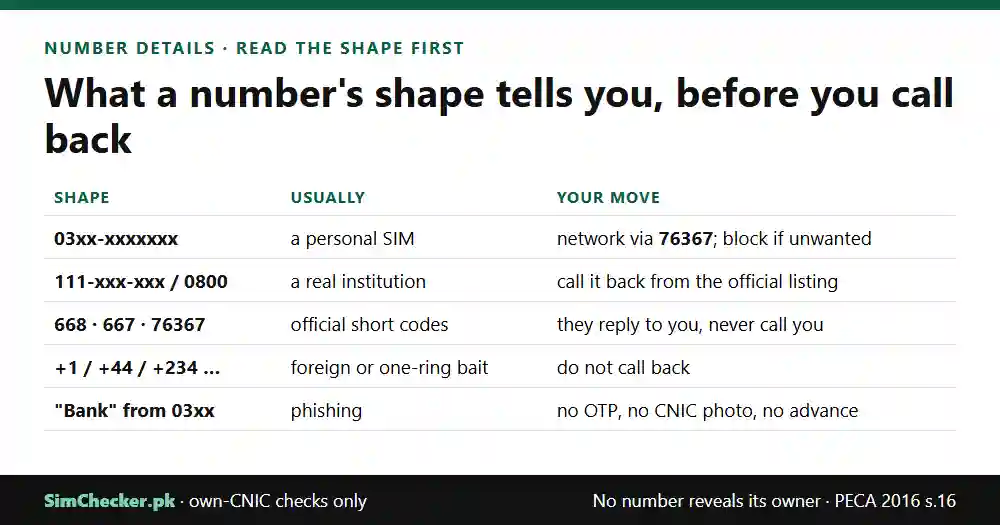
The digits themselves carry a first layer of number details: what kind of line it is. A bank, a government office and a scammer usually reach you through different shapes, and the shape is visible before you pick up. The checks themselves are set out on the home guide under sim owner details in Pakistan: the official checks; this page is about reading a number before you reach for any of them.
| Shape | What it is | What that tells you |
|---|---|---|
| 03xx-xxxxxxx (11 digits) | An ordinary mobile SIM on Jazz, Zong, Telenor, Ufone or SCOM | A person, or a business using a personal SIM. Its network is the one fact you can confirm, by texting the number to 76367. |
| +92 3xx xxxxxxx | The same mobile number written in international form | Nothing extra. Drop the +92, put the 0 back, and you have the 03xx number. |
| 021 / 042 / 051 and other city codes | A landline: 021 is Karachi, 042 Lahore, 051 Islamabad and Rawalpindi | An office or a home in that city. A landline is not a SIM, so 76367 has nothing to say about it; the check is built for 03xx numbers. |
| 0800-xxxxx | A toll-free line, the shape PTA uses for its own consumer helpline 0800-55055 | Companies and regulators publish these; a stranger asking you to ring a personal mobile “for the bank” does not. |
| 111-xxx-xxx | A universal access number, the corporate shape operators and banks publish — SCOM’s 111-726-726, for instance | One number for the whole country. Ring an institution back on a line it publishes; the 03xx line a text arrived from is not one. |
| 3 to 5 digits: 668, 667, 76367, 1799 | Official services: PTA’s SIM checks by SMS, NCCIA’s helpline by voice | 668, 667 and 76367 answer a text you sent; 1799 and 0800-55055 are lines you dial. None of them place calls to you, so treat a call that shows one of these as fake. |
| +1, +44 and other foreign prefixes | An international number, or a caller ID faked to look like one | A missed call you were not expecting is the classic one-ring bait. Calling back is what earns the caller money. |
Two shapes deserve a second look. Banks and PTA push their alerts under a named sender ID and publish 111 or 0800 lines; a courier rider may well ring from a personal mobile, but a message from a plain 03xx number that asks for a code, a payment or a click fails its first test. And a short code that appears to be calling you cannot be what it claims: 668 and 667 only ever reply to a text you sent.
Every shape above describes a number that reached you. Your own CNIC is a different question, handled on two companion pages: the sim counter for how many SIMs are registered against it, and the SIM ownership check for what the SIM in your own phone is registered as.
Seven situations, one at a time: what the number settles and what you do next
Each situation below gives the same three things: what a number check can genuinely settle, what it cannot, and the step that closes the matter without touching a lookup site.
1. A 03xx number you do not recognise keeps calling
What the number settles: its network, by SMS: N, a space, then the number, sent to 76367 from any Pakistani SIM, about Rs 2 plus tax. What it cannot settle: who is holding the phone. No official service, app or website converts a mobile number into a person’s name, CNIC or address, and the searcher is caught by the same law as the seller: see what PECA Section 16 punishes. The step: block the number on the phone; if it moves to a second number or turns threatening, file with NCCIA on 1799 with screenshots and the exact numbers. Investigators can obtain subscriber details under legal process; you cannot, and nobody selling them can either.
2. A missed call from a foreign number
What the number settles: only the country code, and even that can be faked. What it cannot settle: whether a real person is behind it. The step: do not return the call. One-ring fraud works by making you dial a premium or revenue-sharing line abroad; the charge lands on your bill and nobody was ever trying to reach you. If the same number rings repeatedly, tell your operator — dial 111 for Jazz, 310 for Zong, 345 for Telenor or 333 for Ufone — and block it. A genuine overseas relative will usually message on WhatsApp, or ring again and stay on the line.
3. A “bank”, “courier” or “PTA” message from an ordinary mobile number
What the number settles: almost everything. Banks and PTA send under a named sender ID and take calls on published 111 or 0800 lines; a 03xx sender is a personal SIM, and 76367 will simply name the network carrying it today. What it cannot settle: nothing you still need to know. The step: never share a one-time code, a CNIC image or a card number in reply, and never ring the number in the message. Dial the helpline printed on your card or on the institution’s own website and ask whether the message was theirs. PTA has publicly warned that “your SIM is suspicious, it will be suspended, click here” texts are phishing; the same goes for any “verify your account” link, whoever claims to send it.
4. A WhatsApp number offering a job, a prize or an investment
What the number settles: the country code WhatsApp displays, which is often not Pakistan. What it cannot settle: the identity of the account, because WhatsApp accounts are tied to SIMs and SIM ownership is not public. The step: report and block inside WhatsApp, which flags the account to the platform; if money changed hands, report to NCCIA on 1799. A profile photo, a company logo and a professional tone are free to fake; a registered office number and a published website are harder to fake, and a legitimate employer gives you something to verify — an office line, a named person — before it asks for anything.
5. A buyer or seller on a marketplace gives you their number
What the number settles: whether it is a live Pakistani mobile (it rings, it receives SMS) and which network serves it. What it cannot settle: whether the person is honest, whether the item exists, or whether the account will still exist tomorrow. The step: treat the number as a contact, not a credential. Refuse advance payments and “delivery charges” sent to a wallet; meet in a public place or use cash on delivery; keep the conversation inside the marketplace app, where the account history is visible and reportable. A seller who insists on moving to WhatsApp and paying first has answered your question for you.
6. You found a phone or a SIM and want to know whose it is
What the number settles: nothing you need. The SIM’s own record exists, but it belongs to whoever registered it, and pulling that person’s name and CNIC is the exact act Section 16 covers. What it cannot settle: any right to keep or use the line. The step: switch the phone off, hand it in at any franchise of the network printed on the SIM, or to the police, and let them reach the owner. Do not text 667 from it, and do not make calls from it.
7. You want the details of a line on your own CNIC
What the number settles: nothing on its own, because the right question here is about your CNIC, not a number. That count comes from 668 or the portal, both walked through on the 668 and 667 steps, and either way you get a per-operator count, not the numbers. The step: for the numbers themselves, take your original CNIC to that operator’s franchise; a fingerprint opens the lines that operator has on you, and you can ask for any you do not recognise to be blocked. The walkthrough is in the SIM information guide.
The five-question trust test for any number that contacts you
Run these in order. A number that fails any one of them has said enough; you do not need its owner’s name to hang up.
- Does the shape match the claim? A bank on a 03xx line, a courier on a foreign prefix, “PTA” ringing you from a personal mobile to threaten a block: the shape contradicts the story before a word is spoken.
- Does 76367 agree? Text the number and read the network. It will not name anyone, but a caller who says “I am ringing from Jazz’s head office” from a line 76367 places on another network has already slipped.
- Can the official channel confirm it? Hang up, dial the helpline printed on your card, statement or the organisation’s website, and ask. Real requests survive this; fake ones evaporate.
- What are they asking for? A one-time code, a CNIC photo, an advance payment, a “refundable” fee or remote access to your phone. No legitimate caller needs any of these to help you.
- Can you reach them somewhere published? A registered office, a 111 or 0800 line, a listed email. If the only route is the number that contacted you, treat it as unverified until proven otherwise.
What each official check gives back, in one table
| You want to know | The check | The reply | Cost |
|---|---|---|---|
| Which network a number is on | SMS N 03xxxxxxxxx to 76367, from any Pakistani SIM | The current operator, correct even after porting | About Rs 2 plus tax |
| Your own SIM’s record | SMS MNP to 667 from that SIM | The registered name and CNIC (part-masked); some replies also carry the activation date | Ordinary SMS rate |
| How many SIMs sit on your CNIC | SMS your 13-digit CNIC (no dashes) to 668, or cnic.sims.pk | A count per operator; no numbers, names or dates | By SMS, charges may apply (historically Rs 2); free on the portal |
| Your own number when you forgot it | Jazz *99# (operator-published); Zong *8#, Telenor *8888#, Ufone *780*3# (community-confirmed) | Your number on screen | Free |
| Who is behind a threatening or fraudulent number | Report to NCCIA on 1799 or its complaint portal | An investigation that can obtain subscriber details under legal process | Free |
| Who a stranger’s number belongs to | No check | Nothing; whatever a page shows is old leaked rows or made up | Your details, and possibly a case against you |
The codes above are explained field by field on the main guide, which sets out what number details mean and every network’s own-number code; 668 and 667 are covered there too. For a check-by-check reference across every official route, the sister guide at cnicsiminfo.pk lists them in order.
Three number-details beliefs that cost people money
“The prefix tells me the network, so I do not need 76367”
It told you the network once. Porting lets a number leave the operator it was born on without changing a digit, so the prefix is a birth certificate, not an address: the main guide explains how porting moves a number. 76367 is the check that answers for today.
“The prefix tells me the city”
Landline codes do: 021 is Karachi, 042 is Lahore. Mobile numbers are allotted to operators, not to cities, and a 0300 line bought in Quetta works and looks identical in Lahore. Any page that turns a mobile prefix into a district is inventing the district.
“Some site somewhere can show the owner if I pay”
The sites exist; the owner data does not. PTA’s registry answers a CNIC holder about their own SIMs and answers nobody about a number, so every paid “result” is a stale breach row, a guess dressed as a record, or an invention — and the form you filled in is now the site’s newest entry. The pattern is taken apart on the “sim database” and sim data page, and the safety fallout on SIM safety and problems.
Questions people ask about number details
Which number details can I actually check before calling back?
Decide first what you need. The network: text the letter N followed by the number, then send it to 76367, for about Rs 2 plus tax. The record of your own SIM: text MNP to 667 from it. The SIMs on your own CNIC: send your CNIC to 668, or use the free cnic.sims.pk portal. Those three are the whole list; a stranger’s name, address or location is not available to the public through any of them or through any website.
Which of the official number checks cost nothing?
Two of them: cnic.sims.pk shows the SIM count on your own CNIC, and every operator’s own-number code shows your own number. The 76367 network check is an SMS, not a website, and costs about Rs 2. When a page offers a stranger’s record for free, you are the product: every number and CNIC you type is what it keeps.
Can I check phone number details with the owner’s name?
Only for your own SIM, by texting MNP to 667 from it, which returns that SIM’s registered name and a CNIC that some operators partly hide. For any other number the answer is no: PTA’s registry is not searchable by the public, and Section 16 of PECA 2016 treats the person doing the search as an offender alongside whoever sold the data.
Is a mobile number details search with name and address possible?
Not lawfully, and not accurately. Addresses live in NADRA’s records and operator files, neither of which has a public lookup. Pages that display a name and address for a number are showing old leaked rows or fabricated entries, and using them exposes the visitor, not just the site, to PECA penalties. Harassment is a job for NCCIA on 1799: an investigator can put a name to the line; you cannot.
What are number owner details, and can I get them?
Owner details are the registration record behind a SIM: the name and CNIC it was sold against. They are visible to the owner, through MNP to 667 from that SIM, and to law enforcement under legal process. They are not visible to anyone who merely has the number, and no check, code, app or website changes that.
How do I tell which network a caller’s number is on?
Put the caller’s number after the letter N and send it to 76367; the reply is the operator that carries the number now, ports included. The first digits show which operator the number was first issued to, and nothing more.
Can I find out who is calling me from an unknown number?
Not by looking the number up. You can learn its network from 76367, read the caller’s intentions from what they ask you for, and block or report the line. If the calls are threatening or fraudulent, a report to NCCIA on 1799 starts the one process that can lawfully identify the caller.
Kisi anjaan number ki details kaise pata karein?
Sirf network pata chalta hai: “N” ke baad number likh kar 76367 par bhej dein, jawab mein operator ka naam aata hai (Rs 2 ke qareeb). Us number ke peechay kaun hai — naam, ghar ka pata, shanakhti card — yeh kisi bhi tareeqe se aam aadmi ko nahi milta, aur jo website yeh bechne ka daawa kare woh purana leak data ya jhoot dikhati hai. Number tang kare to block karein, aur dhamki ya fraud par NCCIA 1799 par report karein.
Roman Urdu Mein: Anjaan Number, Bank Ka Message, Sauda — Kya Check Karein
Qanoon ke mutabiq number se bas yeh milta hai: yeh kis qisam ki line hai aur kis network par hai. Iske aage jo faisla hai woh haalat dekh kar hota hai, number dekh kar nahi.
Anjaan 03xx number baar baar call kare
76367 par N aur number bhej kar network dekh lein, phir block karein. Naam ya pata kisi tareeqe se nahi milta; dhamki ho to NCCIA 1799 par screenshot ke saath report karein.
Bahar ke mulk se missed call aaye
Wapas call na karein. Yeh one-ring fraud hai jisme aap ki wapsi call par paisa katta hai. Asal rishtedar aam tor par WhatsApp par message karega ya dobara call kar ke line par rahega.
Bank, courier ya PTA ka message aam mobile number se aaye
Bank aur PTA apne naam se message bhejte hain aur 111 ya 0800 lines dete hain; jo 03xx number OTP, paisa ya link maange, wahi galat hai. OTP, CNIC ki tasveer ya card number kabhi na bhejein; apne card par likhi helpline par khud call kar ke poochein.
OLX ya kisi bhi sauday mein number mile
Number sirf rabta hai, saboot nahi. Advance ya “delivery charges” wallet mein na bhejein; cash on delivery ya public jagah par milein, aur baat app ke andar hi rakhein.
Phone ya SIM mili ho
Us SIM se koi code na bhejein aur na call karein; phone band kar ke us network ki franchise ya police ko de dein — malik tak woh khud pahunchenge. Kisi aur ki SIM istemaal karna PECA 2016 ki Section 16 mein jurm hai.
Where the facts on this page come from
76367: PTA’s own line on cnic.sims.pk, which says the network of any number can be checked by sending N and the number (N 03XX-XXXXXXX) to 76367 for Rs. 2 + tax · 667 reply fields: PTA MNP Porting Process Guidelines V7.9.15, 13 February 2020 · PTA FAQ “SIM(s) Information”: 668 and the portal both return counts · Section 16 text and penalties: PECA 2016, Pakistan Code consolidated text · NCCIA helpline 1799 · PTA Consumer Support Centre 0800-55055 · SCOM UAN 111-726-726, used above as the example of the 111 shape · own-number codes: Jazz *99# as published by Jazz; the Zong, Telenor and Ufone codes are community-confirmed · phishing warnings: PTA public advisories on deceptive links. Reviewed by Muhammad Zayan on 4 September 2026.
Where to go next
The home guide sets out the steps for a caller who will not stop. From here, three companion pages carry one piece further: what a SIM tracker can and cannot follow, the full list of network and ownership codes, and why the paid “pak sim data” sites cannot deliver what they promise.