
Own-CNIC checks only · Reviewed 29 September 2026 · PTA’s own words and reported leak cases
There is no public “sim database” in Pakistan, and no website or app can show who owns a phone number. The lawful answer to a “sim data check” starts with your own count: your 13-digit CNIC, entered free on cnic.sims.pk or sent by SMS to 668 (charges may apply, historically Rs 2), returns how many SIMs each operator has registered against it.
What Does Exist: “Sim Data” in PTA’s Own Words
PTA has used “SIM data” for a subscriber’s information about their own SIMs: it titled one release on the 668 service “Mobile Users Seeking Their SIMs Data Through ‘SIM Information System 668’” and wrote that subscribers “have sought their SIM(s) data” through it. Its FAQ on SIMs per CNIC uses the reverse phrase, “data SIMs”, for a kind of SIM rather than a record, one that counts toward the per-CNIC SIM limit. Which body keeps which part of a SIM record is set out in who holds the SIM record.
What a Lawful Check of Your Own SIM Record Shows
Beyond the count at the top of this page, the SIM in your own phone has a check of its own: the MNP 667 reply, field by field.
Every other reason people type “sim data check”, “sim database check” or “sim data online check” is matched to its own official check in which SIM check you need; the counting steps are in how many SIMs are on my CNIC, step by step, and the sites that promise more are examined in the “pak sim data” lookup sites, name by name.
“Sim data check karne ka tarika” aur “mobile sim data check karne ka tarika” ka jawab apne CNIC par SIM ki ginti se shuru hota hai, jo is page ke shuru mein hai; SIM check karne ka poora tarika alag page par hai.
“Sim Database Online”: What PTA Said About Subscriber Data Offered Online
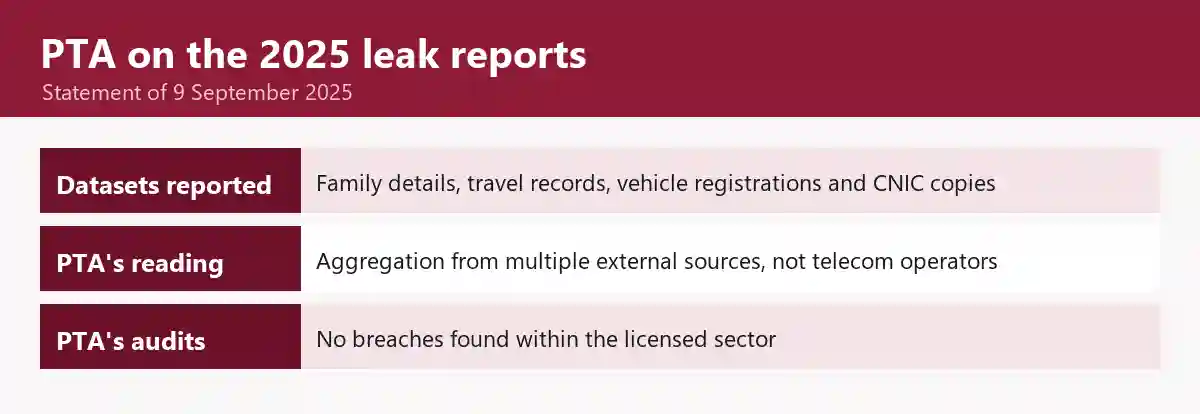
“Sim database online” asks for SIM records on the open web; on 9 September 2025, responding to media reports on the “alleged availability of subscriber data online”, PTA said it had blocked 1,372 sites, apps and social media pages involved in selling or sharing personal data.
Adding a year (“sim database 2026”) or the word “cnic” (“sim database online cnic”), or typing the phrase run together as a web address (“simdatabaseonline”, “onlinesimdatabase”, “simdatabase.pk”), does not change the answer at the top of this page.
Scams built around SIM checks are covered in eight SIM scams and the tell each one gives away, and what a genuine service would have to pass in the test any real SIM service must pass.
“Fresh Sim Data” and “Fresh Sim Database”: What the Word Promises
“Fresh sim data” and “fresh sim database” are the same search with one word added, and that word promises a newer list than the last one; what has actually been reported is set out under leaked SIM and identity data: reported cases. “Fresh sim database 2026”, “fresh database sim”, “freshsimdatabase”, “freshsimdatabases.com”, “new sim database”, “live sim data” and “live fresh sim data” make the same promise.
“Sim Data Update”: Who May Correct a SIM Record
For a change to a SIM record today, the routes are covered in the counter transactions that need biometric verification against NADRA, a record tied to an expired CNIC in PTA’s 2026 warnings on expired CNICs, and a ported number left unused in what happens to a ported number you stop using.
In a release from the 668 service’s early days, when Mobilink and Warid were still separate networks, PTA allowed selected franchises “to only receive the complaints regarding SIM data”, not to correct or amend it, and said of the correction: “This shall only be done by mobile company.”
“Sim data updates”, “sim data update.com”, “simdataupdate” and “simdataupdate.com” ask the same question, typed as one word or as a web address.
“Sky Sim Data”: Every Spelling, and Where Each One Is Answered
“Sky sim data” is searched in many spellings, from “sky sim data come” to “sky sim data pakistan free apk”, and the table below sends each one to the single place on this site that answers it.
| Spelling people type | What it asks for | Where it is answered |
|---|---|---|
| “sky sim data”, “sky sim data come”, “sky sim data.com”, “sky simdata.com”, “skysim data.com”, “sky sim data dot com” | The label itself, or the label typed as a web address | The answer at the top of this page |
| “sky sim data number”, “sky sim data details”, “sky sim data details by number”, “sky sim data number check” | A stranger’s name and CNIC from a mobile number | What a Pakistani mobile number does return |
| “sky sim data free”, “sky sim data check”, “sky sim data check online by cnic” | A free check | The count at the top of this page |
| “sky sim data pakistan free apk”, “sky sim data app”, “sky sim data apk” | An install file from outside the app store | What Android itself says about these install files |
| “sky fresh sim database”, “sky fresh sim data” | Two labels joined together | What “fresh” promises |
Leaked SIM and Identity Data: Reported Cases, 2024 to 2026
SIM and identity data has been reported leaked or offered for sale in Pakistan more than once since 2024, and some of those cases led to NCCIA arrests; the table sets out reported cases, oldest first, with the records each report named.
| Reported | What was reported | Data named | Source |
|---|---|---|---|
| 27 March 2024 | A joint investigation team reported that the particulars of 2.7 million citizens were compromised between 2019 and 2023, with NADRA offices in Karachi, Multan and Peshawar allegedly involved | NADRA citizen data, with evidence of it surfacing in Argentina and Romania | Dawn, 27 March 2024 |
| 8 September 2025 | The interior minister formed a team to probe a reported leak of mobile phone SIMs data, and the NCCIA set up a special investigation team with 14 days to report; PTA’s response of 9 September 2025 is in the figure above | Mobile location information, mobile data records and details of foreign trips (as reported) | Dawn, 8 September 2025 |
| 22 May 2026; Senate briefing reported 22 September 2026 | The NCCIA arrested four people in South Punjab over a network allegedly selling government officers’ data to foreign entities; its later briefing to the Senate Standing Committee on Information Technology described a case against five people | Call records, CNICs and passports (May report); call detail records, travel history, NADRA-linked personal data, family trees, SIM ownership details, subscriber information and location data (September briefing) | Dawn, 22 May 2026; ProPakistani, 22 September 2026 |
| 11 July 2026; PTA release dated 15 July 2026 | On a complaint from PTA’s Lahore zonal office, the NCCIA arrested three people in Lahore over the illegal sale of confidential telecom subscriber information; an FIR was registered | Call detail records, subscriber details, location data and IMEI records (PTA’s complaint); fingerprint and CNIC records (from the seized devices) | PTA, 15 July 2026; The Nation, 11 July 2026 |
| 9 September 2026 | The NCCIA arrested two people in Lahore over the sale of personal data of more than 10 million citizens through an unauthorised website called “Mini NADRA”; about three terabytes of data were recovered | SIM ownership records, call detail records, “SIM databases”, user location data and family tree details | The Nation, 9 September 2026 |
On the label “sim data whatsapp group”: in the July 2026 Lahore case, PTA said analysis of the seized devices revealed “WhatsApp communications related to the unauthorized sale of subscriber data”, and in the network briefed to the Senate committee in September 2026, fake WhatsApp accounts and microfinance bank accounts were allegedly used “to facilitate payments and conceal proceeds”.
Lists like these fall under section 16 of PECA 2016; what the section covers, act by act, is set out in what section 16 covers, and what to do with a file you already hold, and the remedy for a person whose details are in one in the section 16(2) remedy and the 2025 change of Authority. A site or seller offering such data is reported through reporting a lookup site or data seller; if your own CNIC may be in such a list, start with a SIM on your CNIC that you never took.
Where the Facts on This Page Come From
The count routes: PTA FAQ on checking the SIM count (undated), accessed September 2026; charges may apply: PTA release of 31 December 2025 · Rs 2 per SMS at launch: PTA release on the launch of the SIM Information System (no date printed; issued at the service’s launch) · “SIMs Data” and PTA’s early franchise rule on correcting SIM records: PTA release “Mobile Users Seeking Their SIMs Data Through SIM Information System 668” (no date printed; issued in the 668 service’s early days, when Mobilink and Warid were separate operators) · cnic.sims.pk: the portal page, accessed September 2026 · “Data SIMs”: PTA FAQ on SIMs per CNIC (undated), accessed September 2026 · Blocked sites and PTA’s reading of the 2025 datasets: PTA, “PTA Clarifies Alleged Data Leak Reports”, 9 September 2025 · Section 16: PECA 2016, Pakistan Code consolidated text · The reported cases: PTA, “PTA Takes Action Against Illegal Sale of Confidential Telecom Subscriber Data”, 15 July 2026; Dawn, 27 March 2024; Dawn, 8 September 2025; Dawn, 22 May 2026; The Nation, 11 July 2026; The Nation, 9 September 2026; ProPakistani, 22 September 2026. Reviewed by Muhammad Zayan on 29 September 2026.
Where to Go Next
The named lookup sites and data sellers are taken one by one in the full guide to “pak sim data” lookup sites and data sellers. For the questions that sit beside this one, read what a SIM tracker can legally track, how many SIMs are on my CNIC and acting on a SIM that is not yours.