
Lookup-site names and the law · Reviewed 29 September 2026
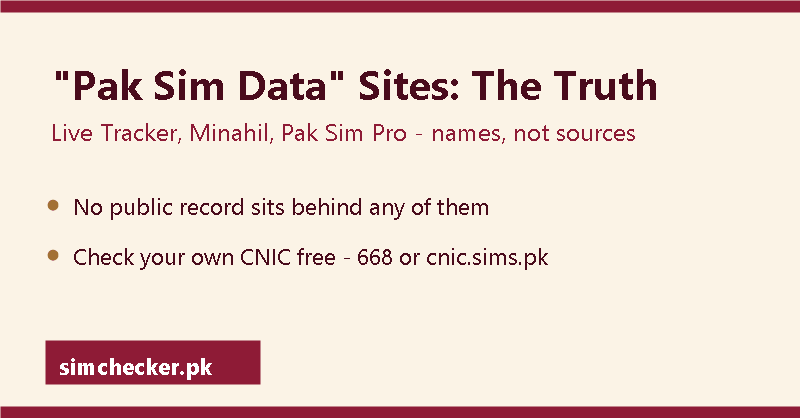
“Pak sim data”, “pak sim pro”, “minahil sim data” and “sims bio” are search terms, not services, and no website or app can show who owns a phone number. The lawful check on a CNIC reads only your own record: a per-operator SIM count on your 13-digit CNIC, free on cnic.sims.pk or by SMS to 668 (charges may apply, historically Rs 2), against the eight-SIM limit, five voice and three data.
What “Pak Sim Data” Refers To, and Where the Record It Asks For Is Made
“Pak sim data” is a search phrase for a public register that would match mobile numbers to names and CNICs; the record it has in mind is the registration made when a SIM is sold, after the buyer’s fingerprints are verified against NADRA on a biometric verification (BVS) scanner at the counter. The same request is typed as “pak sim database”, “pak sim data base”, “paksimdata”, “pak data sim”, “pak data cnic” and “pak sim data cnic”, and no spelling changes what exists. The counter step itself is set out in how a SIM is registered at the counter, and the wider question in whether a public “sim database” exists.
Site Names Searched With “Pak Sim Data”, and What Each One Is
No name in this family changes the answer, and each row below points to the one page or section where the question behind that name has a lawful answer.
| Label people type | What it is | Where to go |
|---|---|---|
| “pak sim data check online free”, “pak sim data check”, “pak sim data online check” | A search for a free online check | The portal and 668 steps |
| “minahil”, “manahil”, “minhal sim data” | One name spelled three ways, searched “by number” and “by CNIC” | By number: the promises table under the four checks. By CNIC: the steps in the first row. |
| “pak sim pro”, “paksimpro”, “pakistan sim pro”, “simpro.pk” | The same search under a product-like name | The network-name question below |
| “pak sim ga”, “paksim ga”, “pak data cf”, “pak sim data ml”, “sims.bio” | Names ending in .ga, .cf, .ml or .bio | What those endings mean |
| “stability note”, “stability no.com”, “stability note pta” | A site name typed with “pta” and “sim data”; PTA’s own count service is titled the SIM Information System | The steps in the first row |
| “cnic shop” | A name built from the words “CNIC” and “shop” | What the law gives the person whose details are traded; reporting a seller |
| “simownerpk”, “global daily info” and any name not in this table | A site name; no table can list them all | The four checks |
| “live tracker” | SIM tracker apps and what can legally be tracked | |
| “sim data update” | Who may correct a SIM record | |
What do “pak sim ga”, “pak data cf”, “pak sim data ml” and “sims.bio” mean?
The letters after the dot name a domain registry, not a data source: .ga is Gabon’s country-code ending, managed by ANINF, .cf is the Central African Republic’s, managed by SOCATEL, and .ml is Mali’s, according to the IANA root zone database.
“Sims bio” and “sims.bio” use .bio, a generic ending whose sponsoring organisation is Identity Digital Limited. None of these endings is a Pakistani registration, and an ending says nothing about whether a site holds any SIM record.
Is “pak sim pro jazz” or “pak sim data zong” a different search from “pak sim pro”?
No: a network name added to any of these labels, whether “pak sim pro jazz”, “pak sim data zong”, “pak sim pro telenor” or “pak sim ga ufone”, makes it the same search as the label without it. What each network lets its own customers check is on that network’s page: Jazz SIM owner details, Zong SIM owner details, Telenor SIM owner details, Ufone SIM owner details, and Onic and SCOM SIM owner details.
The Test Any Real SIM Service Must Pass
PTA’s and the networks’ own routes pass all four checks below; a page that promises the registered owner’s name or CNIC behind someone else’s number fails at least one of them, the third, by its own promise, whatever it is called.
- It is PTA’s or a network’s own route. 668 and cnic.sims.pk are named in PTA’s own FAQ, 667 in PTA’s MNP porting guidelines, and 76367 on the portal PTA names; a network’s own codes answer on that network’s own system. A service that is neither PTA’s nor a network’s own gives you nothing to hold it to.
- It runs on PTA’s or the network’s own SMS short code, dial code, portal or app, never on an install file from outside the app store (what Play Protect says about install files).
- It gives no registered owner’s name or CNIC for a number that is not yours. The official reply that carries the registered name, MNP sent to 667, answers only for the SIM that sends it (how the 667 check works). 76367 accepts any number and returns only the network it is on (what a number’s prefix and network check can tell you). Every official output and its cost is in what each official check gives back, and what it costs.
- It never sells, unlocks or releases another person’s identity information, which is what section 16 of PECA 2016 protects (the section 16(2) remedy).
A number that contacts you, rather than a site you found, has its own test: the five-question trust test for a number that contacts you.
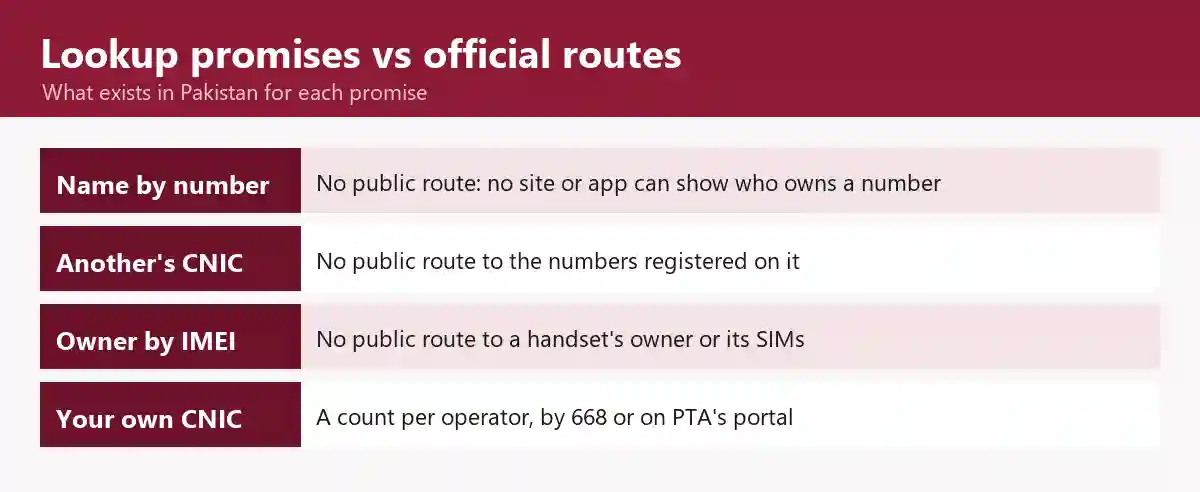
| The promise | Public route | Where the lawful version is explained |
|---|---|---|
| The name and CNIC behind any mobile number | None | What a mobile number can and cannot tell you |
| Every number registered on someone else’s CNIC | None | What the official CNIC check shows |
| The owner or SIMs behind a phone’s IMEI | None | What an IMEI check never tells you |
“Pak Sim Data APK” Files: What Google Play Protect Says
If a page offers a “pak sim data”, “minahil sim data” or “pak sim pro” install file, that file is an app from outside the Play Store, and Google’s own help page says Play Protect checks a phone for potentially harmful apps from other sources and may prevent the installation of an unverified app that uses sensitive device permissions commonly targeted by scammers to commit financial fraud. An “old version” of such a file, as in “paksim ga pro apk old version” or “pak sim pro apk old version”, is still an app from outside the store. The rest is covered in what a lookup app’s permission sheet and result screen are made of, the ten-minute cleanup if one is already installed and the other scams that borrow SIM-check language.
PECA 2016 Section 16(2): The Remedy When Your Identity Information Is Sold or Used
Section 16(2) of the Prevention of Electronic Crimes Act 2016 gives any person whose identity information is obtained, sold, possessed, used or transmitted a remedy of their own: they may apply to the Authority to secure or destroy that information, block access to it or stop its transmission, and the Authority may take the measures it considers appropriate. Doing any of those things to another person’s identity information without authorisation is the offence in section 16(1), set out with its penalty in what section 16 makes an offence, and the penalty it carries.
Act II of 2025 redefined “Authority” in the Act as the Social Media Protection and Regulatory Authority, to be set up by notification under section 2A, and section 50A kept PTA performing those functions until it was established; the federal government named the new Authority’s first chairman and members in March 2026.
Reporting a Lookup Site or Data Seller: NCCIA 1799, and What PTA Can Do
Report a site, app or chat seller offering other people’s SIM or CNIC details to the National Cyber Crime Investigation Agency on 1799: PTA can block a fraudulent website, but by its own account it needs NCCIA’s recommendation to establish that the site is fraudulent. NCCIA is the former FIA Cybercrime Wing, made an autonomous agency in 2025, and its 1799 helpline was declared fully operational on 3 June 2025.
PTA’s complaint system, at complaint.pta.gov.pk and in its CMS mobile app, takes complaints about unlawful online content from the person affected, with the page’s URL and other evidence, and not from anonymous complainants. For fraud and scams, PTA acts only on an investigative agency’s recommendation or a court order, and it does not take up a matter already pending with an investigative agency.
A SIM on your CNIC that you never took is a separate matter, handled through disowning a SIM you never took, and a call or message from an unknown number follows the fraud and harassment call procedure.
Where the Facts on This Page Come From
668 and cnic.sims.pk as the count routes: PTA FAQ, accessed September 2026; charges may apply: PTA release of 31 December 2025; historically Rs 2: PTA’s SIM Information System launch release · The 8-SIM limit, five voice and three data: PTA FAQ, accessed September 2026 · Fingerprint verification from NADRA on a BVS scanner: PTA’s biometric verification page, accessed September 2026 · 667: PTA MNP Porting Process Guidelines V7.9.15 (PTA guidelines page) · 76367: PTA’s line on cnic.sims.pk, accessed September 2026 · Domain endings: IANA root zone database, .ga (record updated 11 June 2025), .cf (4 August 2026), .ml (3 December 2025) and .bio (4 September 2025) · Play Protect: Google’s Android help page, accessed September 2026 · Section 16(2), the meaning of “Authority”, sections 2A and 50A: PECA 2016, Pakistan Code consolidated text (Act XL of 2016, as amended by Act II of 2025); the new Authority’s first appointments: Dawn, 19 March 2026 · NCCIA 1799: PID release No. 19, 3 June 2025, and Arab News, 3 June 2025 · PTA’s conditions for online-content and fraud complaints: PTA’s Unlawful Online Content FAQ, accessed September 2026, under the Removal and Blocking of Unlawful Online Content (Procedure, Oversight, and Safeguards) Rules 2021; complaint.pta.gov.pk: PTA caution of 18 April 2021. Reviewed by Muhammad Zayan on 29 September 2026.
Where to Go Next
Each name on this page leads back to a question that has its own full guide on this site: the “sim database” and “fresh sim data” question, what a SIM tracker can legally follow, moving, removing or blocking a SIM on your CNIC, and the IMEI check and DIRBS registration windows.