
Own-CNIC checks only · Reviewed 28 August 2026 · This site has no search box
A SIM ownership check in Pakistan works for your own CNIC only: cnic.sims.pk, an SMS to 668, or your operator’s franchise with your original CNIC. All three return how many SIMs sit on your card and which operators hold them — never a name. This page walks each route, what did and did not change for 2026, and the spellings people type on the way here.
On this page: Which online checks are realProving a SIM is yoursWhat changed in 2026Pakistan’s rulesSpellings people type
Related guides: ownership transfer, eSIM and scams · number details, honestly.
Every route here is summarised under sim owner details in Pakistan: the official checks; this page carries the detail.
SIM Check Online: Which Online Checks Are Real
Three online SIM checks in Pakistan are real: cnic.sims.pk for your SIM count, an SMS to 668 for the same count, and an SMS to 76367 for the network behind any number. A fourth, the word MNP sent to 667, shows the sending SIM’s own record. Everything else sold as an online SIM check is repeating one of these, or inventing a result.
The three real checks, side by side
Side by side, the three checks are cnic.sims.pk (free, in a browser), 668 (by SMS; charges may apply, historically Rs 2) and 76367 (Rs 2 plus tax, by SMS). Each one takes a different input and gives a different answer, and none of them reaches the sim owner details of another person. The table proves how narrow those answers are.
| Check | What you send | What you get | Cost and who runs it |
|---|---|---|---|
| cnic.sims.pk | Your own 13-digit CNIC, in a browser | Count of SIMs, split by operator | Free — PTA |
| 668 | Your own 13-digit CNIC, by SMS | The same count, on your phone | Charges may apply (historically Rs 2) — PTA |
| 76367 | N, a space, then an 11-digit number | The network name only | Rs. 2 plus tax — PTA published |
Check 1 — cnic.sims.pk: you send your own 13-digit CNIC in a browser, you get a SIM count, it is free, PTA runs it
Two tabs, a reCAPTCHA next to “Verify:”, one Submit button. No account is created. Searches for nic sims want this same count, and that guide reads the per-operator result line by line.
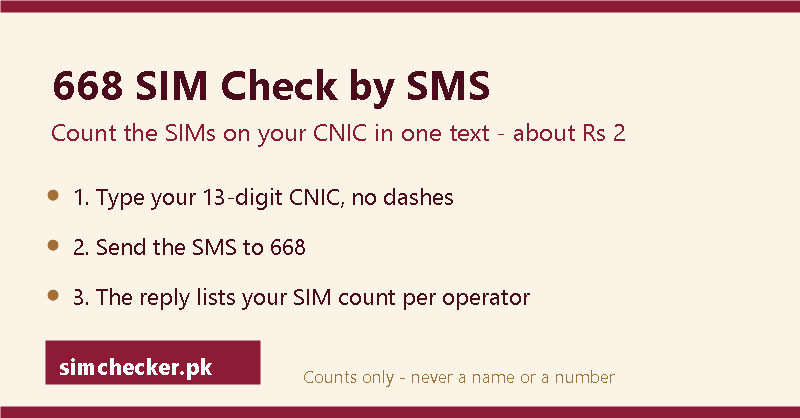
Check 2 — 668: you SMS your own 13-digit CNIC, you get the same count, charges may apply (historically Rs 2), sender-bound
Sender-bound means the reply goes to the SIM that sent it, and to no other handset.
Check 3 — 76367: you SMS N plus an 11-digit number, you get the network name only, Rs. 2 plus tax
Write it as N, a space, then the 11 digits: N 03XXXXXXXXX. The reply names Jazz or Zong or Telenor. No name, no CNIC, no address. Prefixes under the 2008 numbering plan (030x Jazz, 031x Zong, 032x ex-Warid now Jazz, 033x Ufone, 034x Telenor, 035x SCO) are only a hint, since a ported number keeps its old prefix.
Check 4 — 667: you SMS the word MNP from the SIM in your hand, you get that SIM’s own record
Texting MNP to 667 using the SIM in your hand brings back that SIM’s own registered name and part-masked CNIC, and some replies also carry the activation date — see the 668, 667 and 76367 code walkthrough for the reply format. It works only for the SIM that sends the SMS, so it can never read a stranger’s number.
How to tell a real check from a copy
Four tests separate a genuine page from a copy: a named source (PTA or the operator), an own-CNIC input, no promise of a name, and the legal limit stated plainly. A copy fails at least one of the four. Run all four before you type anything.
It names its source, and the source is PTA or the operator
A real page tells you where the answer comes from and lets you go there yourself.
It asks for your own CNIC, never a stranger’s number
The input tells you the truth about what a page can actually do.
It never promises a name or an address
No lawful Pakistani service returns the sim owner details of a stranger, so promising a name is the giveaway.
It states the legal limit in plain words on the same page
A page that hides the law is hoping you do not read it.
Why a lookup box is a warning sign, not a feature
An input field that takes a stranger’s number is a promise nobody can keep. The most a box like that can lawfully return is a network name, which 76367 already gives for Rs 2 plus tax, and no service in Pakistan returns a stranger’s name from a number.
What a stranger-number input box quietly promises
That a name will appear if you type eleven digits. It will not.
What such a box can lawfully return: nothing you cannot already get
At best a network name, which 76367 already gives you for Rs. 2 plus tax.
Why the promise itself creates exposure under PECA 2016, section 16
You hand over your own number and CNIC to a page whose owner you cannot name, chasing sim owner details nobody may lawfully hand you.
Why this site publishes methods and never runs a lookup form
There is no input field on this page, no results panel and no checking animation, because none of those could work honestly.
People also type “simdata check”, “data sim check”, “simdata online” or “sim online details” — one word or two, the real checks stay the same.
Every real check ends at your own record or a bare network name — none returns a stranger’s name.
SIM Ownership Check: Proving a SIM Is Yours
A SIM ownership check proves a SIM is yours; it cannot prove whose a stranger’s SIM is. You run it on your own CNIC through cnic.sims.pk or the 668 SMS service. For written proof, an operator franchise issues confirmation after a biometric scan of your own thumb.
People also search for “sim ownership details online check” and “sim owner details verification” — every one of these points to the same record and the same answer on this page.
The two-minute self-check
The self-check runs six steps on a phone or a laptop: open cnic.sims.pk, type your own 13-digit CNIC, and your count appears on screen. This is where sim owner details start and stop for anyone without a court order.
Step 1 — Open cnic.sims.pk
PTA runs it, under the title “SIM Information System”. No account, no download.
Step 2 — Stay on the CNIC tab
The other tab is Foreign ID, meant for foreign nationals. Pakistani cardholders stay where they land.
Step 3 — Type your 13-digit CNIC with no dashes
Exactly thirteen digits. The field’s own placeholder shows the same shape: your 13-digit CNIC, digits only, no dashes.
Step 4 — Solve the reCAPTCHA next to “Verify:”
A Google reCAPTCHA sits beside that label. Tick it and wait for the green mark.
Step 5 — Click Submit
One button. The answer loads on the same page.
Step 6 — Compare the per-operator list against the SIMs you actually use
Count the handsets in your house first, then read the list. Any line you cannot account for is the reason to keep reading.
Getting written proof at a franchise
Written proof comes from your operator’s own franchise, with your original CNIC and a thumb scan on the BVS scanner at the counter. The portal gives you a number on a screen; a bank or a court wants paper, and that comes from the operator.
Step 1 — Take your original CNIC, not a photocopy
The card has to be the card. A photocopy fails at the counter.
Step 2 — Go to your operator’s own franchise, not a roadside stall
A franchise carries the operator’s own board and staff. The mobile-load stall outside cannot open your record.
Step 3 — Ask for ownership verification on your number
Say the number and what you need it for. The counter has a set process.
Step 4 — Place your thumb on the BVS scanner when asked
BVS is the same thumb scan that registered the SIM in the first place. Your thumb is the password.
Step 5 — Collect the confirmation the franchise issues
Keep it with your CNIC copy. It is the only paper anyone in Pakistan can lawfully hold showing sim owner details for a live connection. If the SIM should move onto your own CNIC permanently, the ownership transfer steps start at this same counter.
What to do about a SIM you do not recognise
Take your original CNIC to that operator’s own franchise, ask for the SIM to be blocked and removed from your CNIC, then file at complaint.pta.gov.pk if nothing happens. A stranger’s SIM on your CNIC is the one result worth acting on the same day. The same removal route sits alongside the 2024–2026 rule changes under the eight-SIM limit and what to do above it.
Step 1 — Note the operator name and how many SIMs it shows
Write down the company and the count before you close the page. A screenshot helps.
Step 2 — Visit that operator’s own franchise with your original CNIC
Go to the company the extra SIM sits under. No other operator can touch it.
Step 3 — Ask for the unrecognised SIM to be blocked and removed from your CNIC
Use those words. Blocking stops the connection; removal clears your count.
Step 4 — If nothing happens, file a complaint at complaint.pta.gov.pk and keep the reference number
The reference number is what turns a conversation into a case. Save it.
Ownership is not tracking
Ownership is a registration record — a CNIC, a thumb scan and a date on the operator’s systems; tracking is live location, which needs a lawful authority under a registered case. People arrive at an ownership check hoping it will do something it was never built to do.
Ownership is a registration record held by the operator
A CNIC, a thumb scan and a date, sitting on the operator’s systems since the day of sale.
Tracking is live location, and it needs a lawful authority
A different thing entirely, done under a registered case by people with legal power.
No website, app or code performs the second one
Any page offering live location alongside sim owner details is describing a crime, not a service. Section 16 of the Prevention of Electronic Crimes Act 2016 covers the identity half of that promise, and it carries up to three years in prison, a fine of up to five million rupees, or both.
Ownership checks confirm your own SIMs and stop at the edge of your own record.
SIM Owner Details 2026: What Changed and What Did Not
Nothing changed in 2026 about who may see a SIM record. The eight-SIM cap still stands, cnic.sims.pk still asks for a 13-digit CNIC and a reCAPTCHA, 668 still replies only to the sending handset, and no lawful route returns a stranger’s name. Year tags on lookup pages signal freshness, not new access.
People also search for “sim owner details pakistan 2026” and “2026 sim owner details” — every one of these points to the same record and the same answer on this page.
What is exactly the same in 2026
Four things are unchanged in 2026: the eight-SIM cap of five voice plus three data, the cnic.sims.pk portal, the sender-bound 668 SMS service, and PECA 2016 section 16. Each one has a date attached to it, set out heading by heading below.
The eight-SIM cap: five voice plus three data, per PTA’s FAQ, which cites a Supreme Court ruling of November 2015
Eight is the ceiling, counted across all operators together, not per company. The “six SIMs” figure repeated on so many pages is wrong and has been wrong since 2015.
The CNIC-only portal at cnic.sims.pk, with its 13-digit field and its reCAPTCHA
Same two tabs, same field taking exactly thirteen digits with no dashes, same Google reCAPTCHA beside “Verify:”.
The sender-bound 668 SMS service
The reply goes to the SIM that sends the SMS, and it contains a count per operator, never a name — in 2026 as in every year before it.
PECA 2016, section 16, and its penalty of up to three years or up to Rs 5,000,000, or both
The offence covers obtaining, selling, possessing, transmitting or using another person’s identity information without permission. Ten years old and still the wall every stranger lookup runs into. The full wording of PECA 2016 section 16 is quoted on the main guide.
What actually changed in 2024–2026
Four real changes landed in 2024–2026, and none of them touched who may see a record. Since 24 January 2024 a second or later SIM on the same CNIC carries a seven-day wait, though the first is issued at once. On 24 May 2026 PTA lengthened the lock before disowning a newly registered SIM from 60 days to 365, with a Rs 200 charge to disown one held under six months. From 17 August 2026 an eSIM costs at most Rs 1,500 under PTA’s fee decision of 7 August 2026, and on 1 July 2026 Telenor Pakistan merged into PTML, Ufone’s parent — existing Telenor SIMs and codes keep working.
What a year label on a lookup page really means
A year label on a lookup page means a re-uploaded file, a new domain, or a fresh advertising push — never new legal access to anyone’s SIM record. A page headed “2026” is telling you something, but not what you think.
“sim owner details online check 2025” and “sim owner details online check by number 2026” are the same search with a new year stuck on, and the same rules meet both.
A re-uploaded file with a new name
The same old list, renamed. Old records do not become accurate by being given this year’s number.
A new domain after an old one stopped working
These sites disappear often. The year in the heading is how the next one announces itself.
A fresh advertising push
The label is there to win the click, because people add the year when they search.
No new legal access of any kind
Nothing about the year changes who may read an operator’s record. Nobody handed out sim owner details in January that they could not hand out in December.
| The 2026 promise | What actually changed |
|---|---|
| “Updated database for 2026” | Nothing. No operator released a public copy |
| “New method that works this year” | The official checks are unchanged |
| “Now shows name and address” | Still an offence under PECA 2016, section 16 |
| “Limit raised to more SIMs” | Still eight: five voice plus three data |
The check to run today, whatever the year on the page
Open cnic.sims.pk, type your own 13-digit CNIC with no dashes, solve the reCAPTCHA and click Submit — four steps, unchanged since the portal opened, and free. The result is your own SIM count, split by operator, read against the eight-SIM limit of five voice plus three data.
Step 1 — Open cnic.sims.pk
PTA’s SIM Information System, and the CNIC tab is where you land.
Step 2 — Type your own 13 digits, no dashes
Digits only, no dashes, exactly as before.
Step 3 — Solve the reCAPTCHA next to “Verify:”
Tick it and wait for the green mark before you move on.
Step 4 — Click Submit and read the count
A total, then a line per operator. If the total sits above eight, take your CNIC to the operator concerned.
People also search “check sim owner details pakistan 2026” and “check sim owner details by number 2026” — the year changes, the answer does not. “sim owner 2026” and “new sim owner details” queries spike every January; nothing above moved.
The rules that block stranger lookups did not move in 2025 or in 2026.
SIM Owner Details in Pakistan: The Country-Specific Rules
Pakistan runs a stricter SIM regime than most countries: every SIM is tied to a CNIC through biometric verification, one CNIC carries a maximum of eight SIMs, and PECA 2016 makes unauthorised use of another person’s identity information a criminal offence. Those three rules decide what any Pakistani check can return.
People also search for “sim owner pakistan”, “pak sim details” and “pak sim detail” — every one of these points to the same record and the same answer on this page.
The three rules that shape every check here
Three rules shape every check here: biometric SIM registration, the eight-SIM cap from PTA’s FAQ, and PECA 2016 section 16. Every answer on this page comes back to these three, and each one has a named source behind it.
Rule 1 — Biometric registration: no SIM is issued without a thumb scan matched to a CNIC
The shopkeeper takes your card and your thumb on the BVS scanner. NADRA verified that card when it was issued; the operator matches the live thumb against it at the counter. That match is what creates the record in the first place.
Rule 2 — The eight-SIM cap: five voice plus three data across all operators, the figure PTA’s FAQ gives and traces to a Supreme Court ruling of November 2015
Eight is the total across every company together, not eight with each one. The “six SIMs” number you will see quoted on other pages is wrong.
Rule 3 — PECA 2016, section 16: obtaining, selling, holding, sending or using another person’s identity information without authorisation is an offence
The penalty runs to three years in prison, a fine of up to five million rupees, or both. It applies to the person who looks as well as the person who sells.
Why “live” is a marketing word here
People search for “live sim owner details pakistan” because live sounds like proof. Set the word against the facts.
| What “live” suggests | What is true |
|---|---|
| A feed updating second by second | Only the operator’s own system updates that way |
| A public page connected to that feed | No such connection has ever been granted |
| Fresher data than an ordinary page | Old leaked lists, or nothing at all |
| A different, better result | The same lawful answer as any other search |
What “live” implies to a reader: a feed updating in real time
The word borrows its credibility from live scores and live tracking, where a real feed exists.
What actually updates in real time: the operator’s own internal record
Each network runs its own subscriber system, kept current under PTA supervision: Jazz, Zong, Telenor, Ufone and SCO alike, and Onic’s while its customers move to PTML (Ufone) under PTA’s 11 September 2026 order (helpline 051-111-339-111).
What no public page has: any connection to that record
Not a paid one, not a partner one, not a leaked one that still works. The link does not exist.
Why “live sim owner details” and “sim owner details” return the same lawful answer
Your own count from cnic.sims.pk or 668, and nothing about anyone else. The adjective changes the search, not the law.
Foreign nationals living in Pakistan
A passport or foreign ID has its own tab on cnic.sims.pk — the Foreign ID tab, which takes 3 to 50 letters and numbers — and the run is five steps. What the result screen shows, field by field, is unpacked on the SIM information page.
Step 1 — Open cnic.sims.pk
PTA’s SIM Information System, the same page Pakistani cardholders use.
Step 2 — Click the Foreign ID tab instead of the CNIC tab
The CNIC tab will reject your document. The second tab is built for it.
Step 3 — Type your ID: 3 to 50 letters and numbers, in the letters-then-digits shape of the page’s own example
Letters and digits together are accepted here, which is the difference from the 13-digit CNIC field.
Step 4 — Solve the reCAPTCHA next to “Verify:”
The same Google reCAPTCHA sits on both forms.
Step 5 — Click Submit and read your SIM count
Your total, split by operator, exactly as a Pakistani cardholder sees it.
Short searches — “pak sims”, “sim pak”, “sim pk”, “sim owner pk” — all land on this same system.
Pakistan ties every SIM to a biometrically verified CNIC, and that link is precisely why no public directory exists.
Sim Onwer, Sim Deatils and Other Spellings People Search
Misspelled searches reach the same answer as the correct spelling. “Sim onwer details”, “sim oner details” and “sim owner deatils” are keyboard slips for SIM owner details, and the lawful result never changes: your own SIM count from cnic.sims.pk or 668, and no stranger’s name from any source at all.
Common typing slips and what each one means
Five slips cover most of what lands on this page. The table pairs each one with the phrase it was aiming at.
| What gets typed | What was meant |
|---|---|
| sim onwer details | sim owner details |
| sim oner details | sim owner details |
| sim owner deatils | sim owner details |
| aim owner details | sim owner details |
| sin number details | sim number details |
| sime details | sim details |
| sims details | sim details |
| same detail | sim detail |
| same owner detail | sim owner detail |
| sim honour detail | sim owner detail |
| sims owner detail | sim owner details |
| sims owner details | sim owner details |
| sim detail owner | sim owner detail |
| details of sim owner | sim owner details |
| detail sim number | sim number detail |
| aim owner details by number | sim owner details by number |
| how check sim owner name | how to check sim owner name |
“sim onwer details” — the w and n swapped in owner
Fast thumbs on a small keyboard. The two letters sit side by side in the word, not on the keypad.
“sim oner details” — a missing w in owner
One key never registered. The search still runs, and it still lands here.
“sim owner deatils” — the i and l swapped in details
The most common slip of the five, and the one people never notice.
“aim owner details” — the a key hit instead of the s key
A and S are neighbours on every layout, English or Urdu.
“sin number details” — the n hit instead of the m in sim
Same row, one key over. Nothing about the meaning changes.
Why the answer is identical for every spelling
The systems that hold the record do not read English at all, so a typo changes nothing. cnic.sims.pk takes a 13-digit CNIC and returns a count, 668 reads the same 13 digits by SMS, and the law binds every spelling equally.
The portal reads 13 digits, not English words
cnic.sims.pk takes a CNIC and gives back a count. Spelling never enters it.
The 668 service reads the same 13 digits
An SMS of thirteen digits, answered to the sending handset. No words involved.
The law does not change with your spelling
Section 16 of the Prevention of Electronic Crimes Act 2016 applies whichever way you spell the search.
The correct spelling and the correct check
The correct phrase is SIM owner details, and the correct check is your own 13-digit CNIC entered at cnic.sims.pk — four steps, and the first one is the phrase itself. The result is your own SIM count, split by operator, and nobody else’s.
Step 1 — The phrase is SIM owner details
Three words: sim, owner, details. Worth knowing for the next search.
Step 2 — Open cnic.sims.pk
PTA’s SIM Information System, and you land on the CNIC tab.
Step 3 — Enter your own 13-digit CNIC with no dashes and solve the reCAPTCHA
Digits only — your 13-digit CNIC with no dashes — then the reCAPTCHA next to “Verify:”.
Step 4 — Click Submit and read your own count
Your own record, and only your own. That boundary holds for every spelling above.
The spelling changes; the lawful answer does not.